The Pleasures of Reading in an Age of Distraction
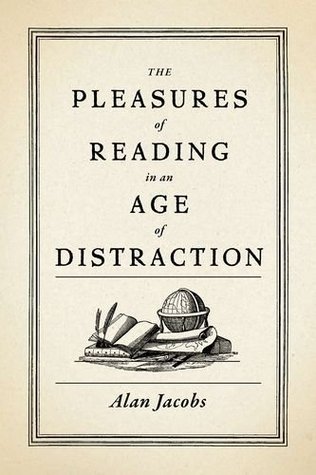
This was a lovely book that was overflowing with wisdom wrapped up in beautiful prose. I read the majority of it out loud to myself as the book recommends itself to that sort of thing. My two favorite chapters in the book are "Whim" and "Lost." If you read nothing else, please read these two chapters. Alan Jacobs ideas and quotes are in roman, while my thoughts are in italics.
"Instead of filling in the blanks—I wanted to be a blank and be filled in." (Quoting Walter Kirn)
I resonate with this idea on a cellular level both in the context Jacobs is intending that there is this desire for reading to fill you, rather than just draining you of your intellectual powers. But I also applied this to people, sometimes it feels like all I do is pour into others and it leaves me dry.
Whim can guide us—because it is based on self-knowledge—knowing oneself, what one needs—the kind of delight one craves.
A significant chunk of the book is dedicated to the subject of whim, by which Jacobs means reading solely for pleasure.
Some days are High Holidays of the Spirit—those are the days to grabble with the complex texts.
“A book is like a mirror—if an ass looks in you can’t expect an apostle to look out.” (Quoting G. C. Lichtenberg)
“One of the great things about books is that they don’t become agitated or dismissive. They patiently bear all the scrutiny you choose to give them—the more carefully you read them the more of their secrets they yield.” (53)
“When I try underlining with a fine point pen I invariably produce lines that look like paths meandering through a forest—and then, of course, I can’t erase the damn things.” (61) Ha! Relatable.
“The possible pleasure of an unread book weight heavier on me than the surer pleasure of the one that I already know.”
“By saying the liberal arts teach you how to think we are really learning how to exercise some control over how and what you think. It means to be conscious and aware enough to choose what you pay attention to.” (Quoting David Foster Wallace)
Attentiveness is worth cultivating because raptness is deeply satisfying
Simone Weil presents a similar idea in her essay, "Reflections on the Right Use of School Studies With a View to the Love of God." She says the kind of attention that school studies and long-form reading cultivate is not just deeply satisfying but improves the depth of one's connection to God. In our age of social media, attention is a precious commodity. To give full attention is an act of reverence. And it is an act of reverence which breeds wholeness.
“You need not see what someone is doing to know if it is his vocation, you have only to watch his eyes: a cook mixing a sauce, a surgeon making a primary incision, a clerk completing a bill of lading,
wear the same rapt expression, forgetting themselves in a function. How beautiful it is that eye-on-the-object look. There should be monuments, there should be odes, to the nameless heroes who first ignored the appetitive goddesses, to the first flaker of flints who forgot his dinner, the first collector of sea-shells to remain celibate. Where should we be but for them?” (Quoting W. H. Auden)
wear the same rapt expression, forgetting themselves in a function. How beautiful it is that eye-on-the-object look. There should be monuments, there should be odes, to the nameless heroes who first ignored the appetitive goddesses, to the first flaker of flints who forgot his dinner, the first collector of sea-shells to remain celibate. Where should we be but for them?” (Quoting W. H. Auden)

Comments
Post a Comment